OpenMail Alternatives for AI Agent Email in 2026

Searching for OpenMail alternatives usually means you're building an agent that sends and receives real email. You need to see what else is available. Agent-native inbox APIs sit closest to OpenMail, while sending-first providers handle outbound and leave the inbox to you. Build your own stack and you take on the maintenance too.
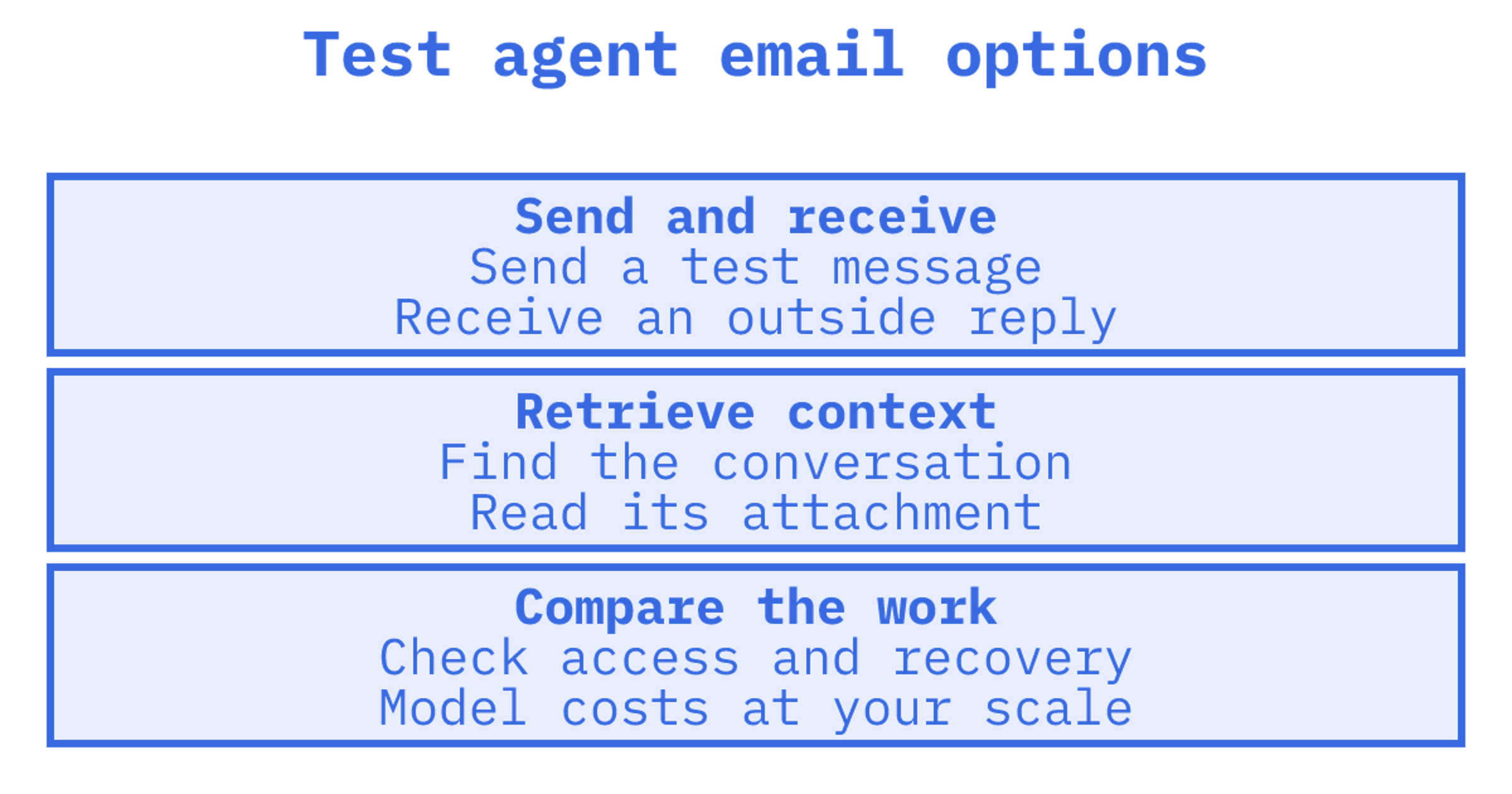
Put each option through a practical test. Send a message, receive a reply and find the thread, then measure the work your agent needs to do next.
TL;DR
- OpenMail, AgentMail, Nylas and Sendmux all give agents inboxes. With sending-first providers such as Resend, Postmark, Mailgun, SendGrid and Amazon SES, check how much mailbox storage you'll need to build.
- Look at the whole read-and-act loop alongside the send endpoint. Check searchable messages, threads, scoped credentials and attachments.
- Give each option one real thread to handle. Send a message, receive a reply, search it and attach a file, then read the result as your agent would.
Table of Contents
1. What you are really replacing
What job does your agent need to do? Answering a customer means retrieving earlier messages, recognising the latest reply and keeping the conversation together. Compare OpenMail with the alternatives below against that job.
- Does the mailbox persist? Your agent may need last Tuesday's thread. Check that searchable message storage comes with the delivery events.
- Who controls outbound? Rate-limit a provider account. Check how the affected agents recover and whether the others can keep working.
- How does cost scale? Work out the per-inbox and per-connected-account charges twice: at five agents, then at five hundred.
- How much work is left for you? Estimate the maintenance you'll take on for the parser, webhook relay and billing integration.
We kept seeing teams piece together a sending provider, a Gmail OAuth workaround, a parser and a webhook relay to give a single agent email. That's why we built Sendmux. The pieces worked individually. Connecting them caused the trouble.
2. The three families of alternatives
Agent-native inbox APIs
OpenMail, AgentMail and Nylas offer agents inboxes. Sendmux sits here too. We'd give each mailbox an ongoing conversation to handle before choosing one for a support or scheduling agent.
Sending-first providers
Resend, Postmark, Mailgun, SendGrid and Amazon SES focus on sending. Follow a reply. Where does it arrive, where is it stored and how does your agent retrieve it? Count the code you'll maintain for tenant-to-address routing and conversation history, and read our why Gmail and SendGrid fall short for agents comparison alongside the test.
Self-built or mail-server stacks
You can run a mail server yourself or connect through IMAP and SMTP. That gives you implementation choices. Authentication, DNS, deliverability and abuse handling become your responsibility too, so weigh the ongoing work against a hosted mailbox's cost.
3. Side-by-side comparison
Build your shortlist from the table. Before committing, confirm each vendor's current features and pricing.
| Criterion | OpenMail | AgentMail | Nylas | Resend, Postmark, Mailgun, SendGrid, SES | Sendmux |
|---|---|---|---|---|---|
| Primary job | Agent inboxes | Agent inboxes | Hosted email identities and account access | Sending, with inbound hooks | Agent mailboxes |
| Persistent, searchable mailbox | Yes, per public listings | Yes | Yes | Usually you build it | Yes |
| Bring your own outbound providers | Not a headline feature | Not a headline feature | Connects to existing accounts | Single provider each | |
| Provider failover and weighted delivery | Check with vendor | Check with vendor | Check with vendor | Not across providers | |
| MCP and CLI | Check with vendor | MCP server and SDKs | Check with vendor | Varies | REST, SDK, MCP and CLI |
| Pricing shape | Check with vendor | Tiered by inboxes | Per account | Per message |
Ask the vendor to demonstrate each "check with vendor" entry using your test mailbox. Write down the result and the integration work it requires.
4. The criteria that separate them
The read side
Start with the agent's reading task. In Sendmux, an agent gets cleaned message text and HTML with quoted history stripped, so it acts on the new reply rather than parsing a raw MIME thread. The raw body endpoints remain when you need the exact original.
Tokens cost money, so retrieval precision matters. The list endpoint filters on folder, thread, free text, sender and recipient, subject, body, arbitrary headers, size range, keywords, date range, attachments and unread state. A count endpoint answers "how many" without returning rows, and search snippets return previews without pulling bodies. Sync endpoints return state tokens, so an agent polls for typed changes rather than re-listing the inbox.
Give each alternative the same retrieval task. Test narrow filters, counts without fetching messages and updates since the last sync, then measure how much data reaches your agent.
The write side
Attachments go as base64 or as an uploaded reference. Check threading headers too. If a reply appears as a separate conversation, your agent can lose the context it needs.
Outbound resilience
Throttle a sending path before you commit. Watch what happens: do messages queue, fail or take another route? Keep our cold email infrastructure for AI agents guide beside your evaluation.
Tenancy and isolation
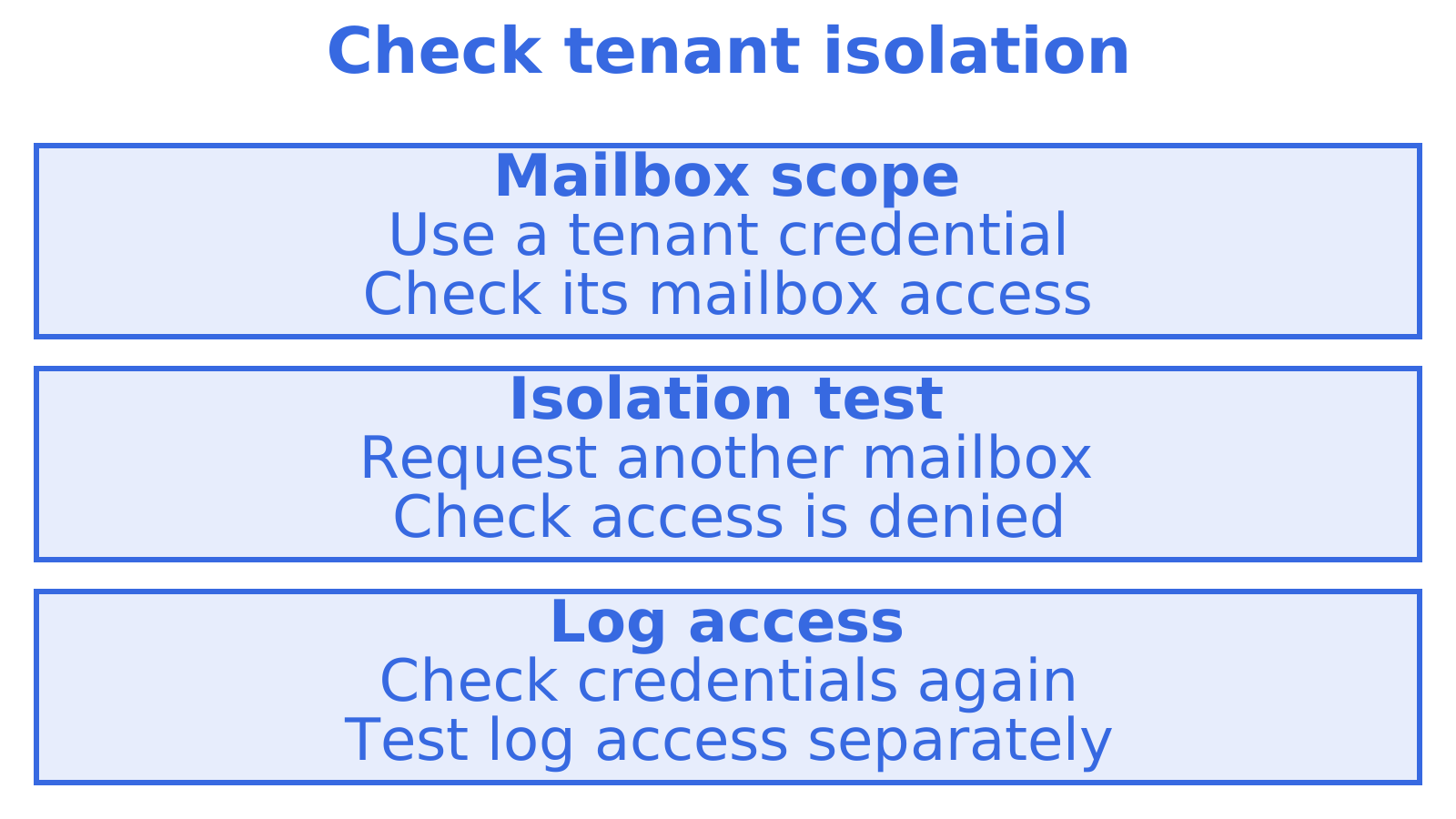
Try retrieving another tenant's messages from a customer account. Check credential scope, then log access. Our multi-tenant email infrastructure page lays out how we handle it.
Domain setup
Put SPF, DKIM and DMARC on your sending-domain checklist. Sendmux verifies custom domains for receiving after you publish the required DNS records. Agent onboarding on @myagent.mx does not require custom-domain DNS setup. Mailboxes can also live on the included @myagent.mx domain, which is useful for prototypes and solo builders.
5. How the options fit different builders
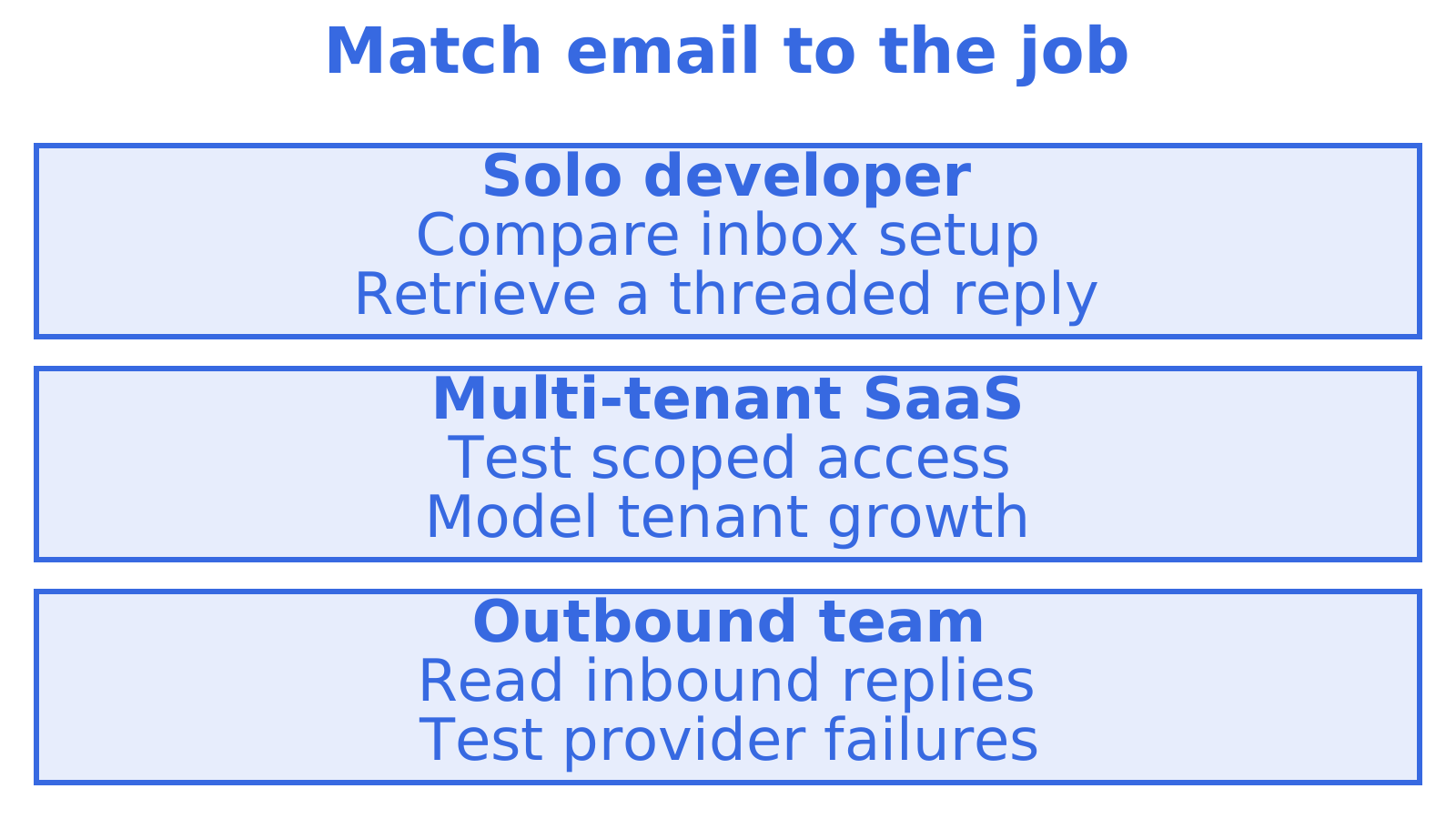
Giving one agent an inbox as a solo developer? We'd check setup time and plan limits, then test MCP support and the steps it takes to retrieve a reply in its thread.
Giving each customer an address in a multi-tenant SaaS? Calculate costs at today's tenant count, then at ten times that count. Test tenant-scoped access and logs before customers arrive.
For a sales or outbound team, test replies as well as provider quotas and failure handling. Compare your requirements with Sendmux's sales outreach agents use case. The wider agency context is in this roundup of email platforms for marketing agencies.
Sending transactional email and handling replies as a product team? Compare the work of adding reply handling to your existing sender with adopting an API that covers both paths.
Using n8n, Make or Zapier? Test the connection your workflow actually needs. Check that it can consume the webhook, event stream or MCP server you're considering.
6. Cost: how to model it honestly
Price the same workload with each candidate. Include mailbox count, messages and storage, along with the retrieval requests your agents make.
Full detail is on the pricing page.
Multiply per-inbox charges by your expected agent or tenant count, and per-account charges by connected accounts. Do it again at ten inboxes and a thousand. Include minimum charges and usage limits in both calculations.
7. Where we think Sendmux fits
Start with the agent's next reply. Can it retrieve enough context to answer correctly?
We built Sendmux because email for agents needs conversation state as well as delivery. Without recall, search and threading, an agent is a fancy autoresponder. Depend on one provider and a rate limit can stop its mail. Per-inbox charges also penalise the architecture we want teams to use for safety: one scoped mailbox per agent, per customer, per workspace.
Every agent or tenant gets a real mailbox with a real address. Retrieval endpoints are built to keep payloads small, because tokens are a cost line. Take one thread and compare the cleaned reply, search preview and full original. Which does your workflow need?
We'd start with a sending-first provider for notifications that never get read as replies. For an agent handling conversations, we'd put Sendmux through a mailbox retrieval test.
8. Try it against your real workload
The fastest way to judge an alternative is a one-hour bake-off. Give each candidate the same job:
- Create a test agent's mailbox. Send it an email from an outside address.
- Ask the agent to reply, then reply to its response yourself. Confirm that the thread stays together.
- Send a PDF attachment and test how your workflow retrieves the file and reads it.
- Find the thread by sender, subject and date. Count unread items without fetching them.
- Throttle one outbound path in the test. Record what happens to delivery.
- Look at the delivery and bounce information the candidate makes available for your test.
Begin your Sendmux evaluation with the agent inbox product page. Teams that want a tool-calling interface can use the MCP and SDK options for agent builders. Comparing AgentMail? Read our AgentMail alternatives guide alongside the results of your own test.
Read sending email and supporting the full inbound workflow are different jobs for another perspective on replies. Then trace the boundary for each candidate: where does its responsibility end and your code begin?
Start with a free Sendmux mailbox
Create a Sendmux account. See the sending API and inbound mailbox options.
Sources
Recommended
Frequently Asked Questions
What is the closest alternative to OpenMail?
AgentMail, Nylas and Sendmux give agents inboxes, so we'd put them alongside OpenMail in a test. Use the same conversation for each: receive a reply, retrieve earlier messages and find the thread by sender and date. Check access controls too, then calculate cost at your expected mailbox count.
Can I use Resend, Postmark or SendGrid instead?
Yes, particularly when your agent mostly sends. Trace a reply before choosing. Where will it be stored? How will your agent retrieve the conversation and keep customers' access separate? Count the mailbox code you'll need to maintain.
Do I need a custom domain?
No. Sendmux has @myagent.mx mailboxes, with onboarding that doesn't require custom-domain DNS setup. To receive on a custom domain, publish the required DNS records and verify it. Review SPF, DKIM and DMARC when preparing your sending domain too.
How does Sendmux pricing compare to per-inbox plans?
Use current prices to calculate the same workload for every candidate. Count mailboxes, outbound and inbound volume, storage and retrieval requests, then check which items each plan bills for. Repeat at ten times your expected mailbox count.
Can I keep my existing Gmail or Outlook sending accounts?
Check each candidate's support for your existing Gmail or Outlook sending accounts. Test authentication and provider quotas. What happens when an account can't send? Account ownership and sending reputation belong in the decision too.
