


One view, every inbox
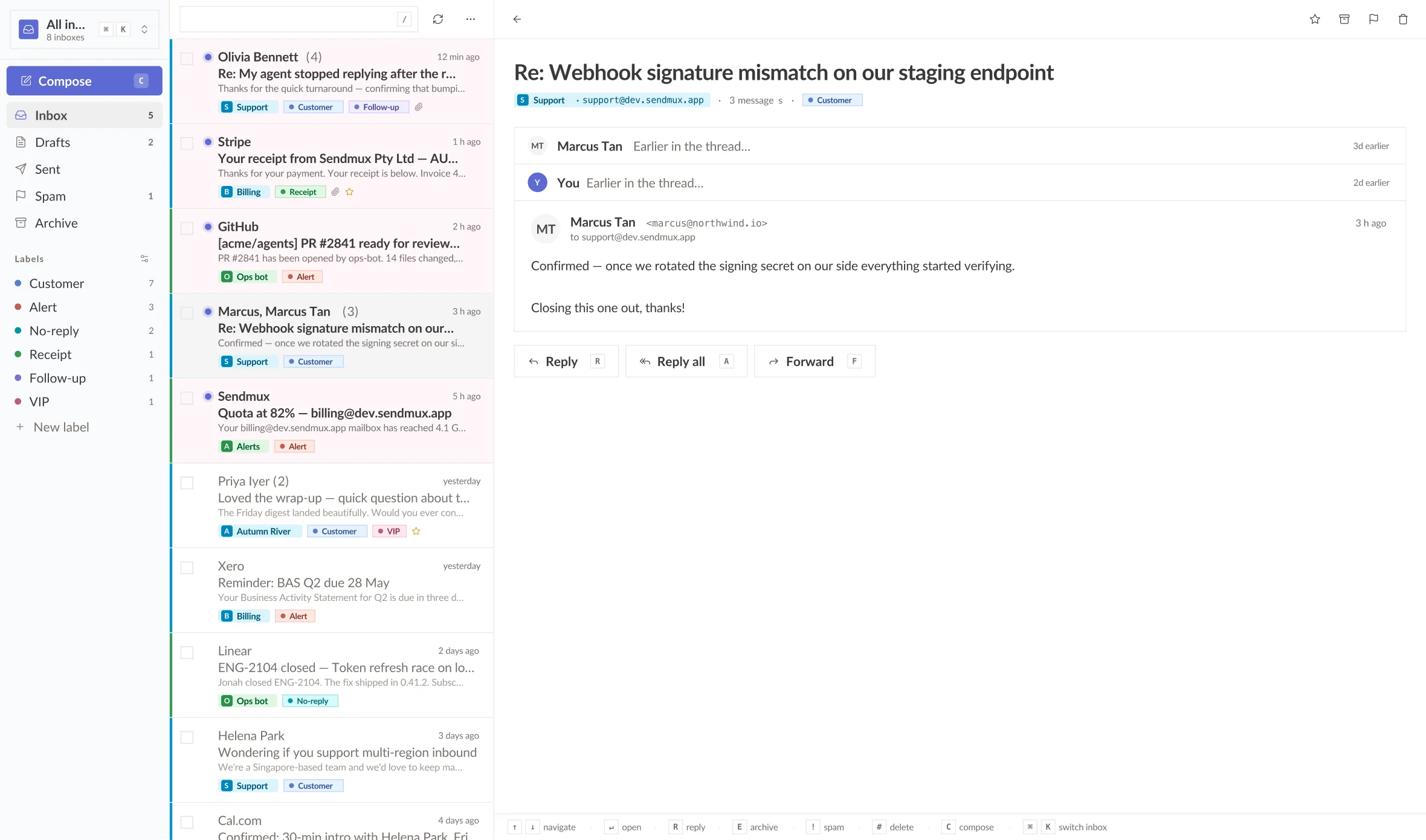
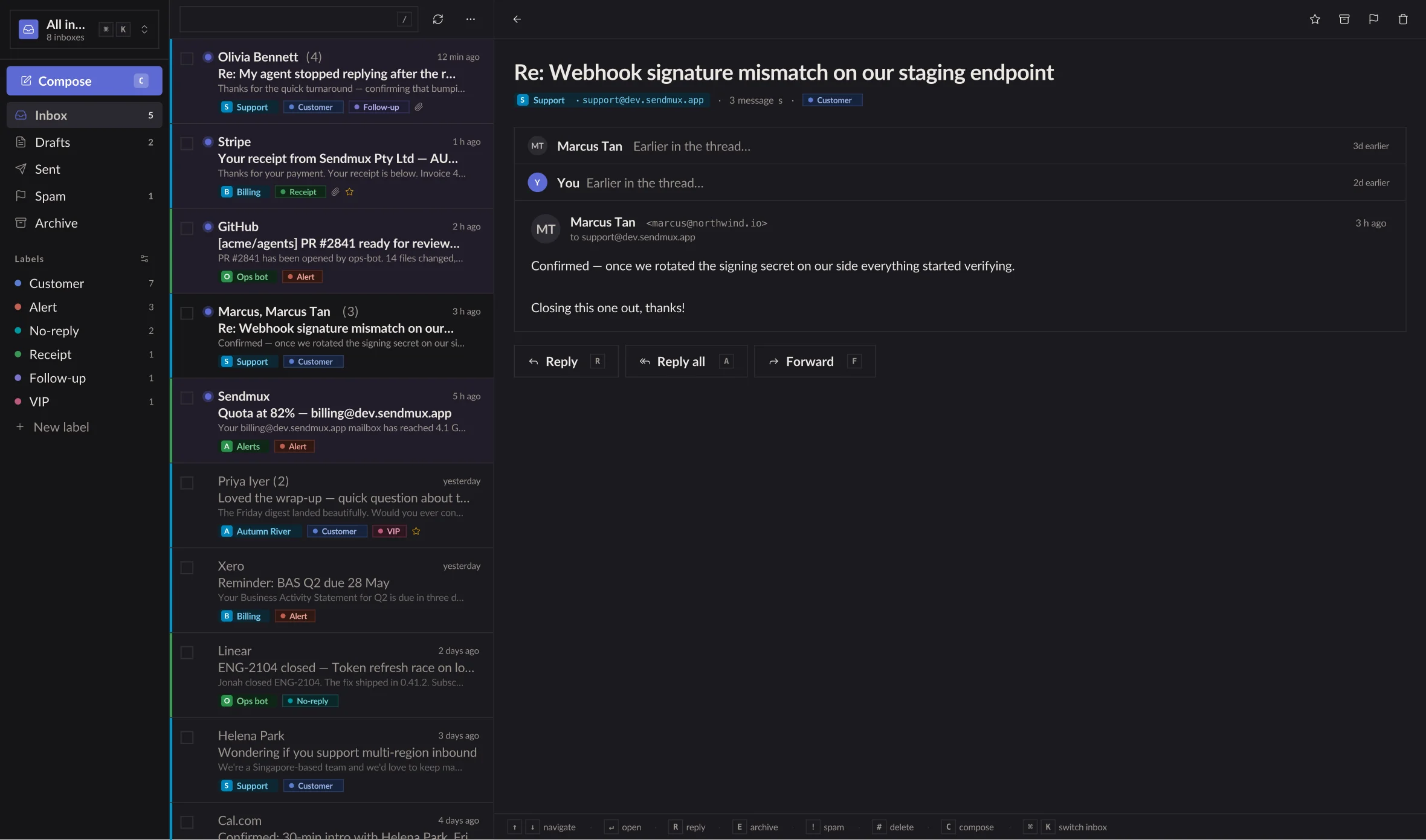
See every agent inbox at once, or click into a single one to focus.
Let your AI agents send and receive email, manage calendars, and store files through one API.
2 free mailboxes
Give your agent an inbox
# Give your OpenClaw agent a real inbox
npx skills add Sendmux/skills

# Then grant the tools, either:
# → connect the hosted MCP endpoint (OAuth)
# https://mcp.sendmux.ai/mcp
# → or create a scoped API key in the dashboard

# Skills teach the workflow; MCP or a key grants access.
# Add the hosted MCP endpoint
claude mcp add sendmux \
    --transport http https://mcp.sendmux.ai/mcp

✓ server added · oauth flow opens in browser
✓ tools scoped to your grant

# your agent now has Mailbox, Sending + Management tools
# Install once
npm i -g @sendmux/cli

# Create a mailbox (requires Management access)
sendmux management:create-mailbox \
    --body '{"email":"agent@myagent.mx"}'

# Stream incoming messages, one JSON object per line
sendmux mailbox:stream-events --follow
import { sending, mailbox } from "@sendmux/sdk";

const smx = sending.createSendingClient({ apiKey: process.env.SENDMUX_SENDING_API_KEY });

// send
await sending.sendingSendEmail({
  client: smx,
  body: {
    from: { email: "agent@yourdomain.dev" },
    to: { email: "sarah@example.com" },
    subject: "Re: invoice 4187",
    html_body: "<p>Confirmed for Tuesday.</p>",
    text_body: "Confirmed for Tuesday.",
  },
});

// receive over server-sent events, no polling
const inbox = mailbox.createMailboxClient({ apiKey: process.env.SENDMUX_MAILBOX_API_KEY });
for await (const e of mailbox.streamMailboxEvents({
  client: inbox,
  query: { event_types: "message.received" },
})) reply(e);
import os
from sendmux_sending import EmailSendRequest, EmailsApi, create_sending_client
from sendmux_mailbox import create_mailbox_client, iter_mailbox_events

smx = create_sending_client(api_key=os.environ["SENDMUX_SENDING_API_KEY"])

# send
EmailsApi(smx).sending_send_email(
    EmailSendRequest.model_validate({
        "from": { "email": "agent@yourdomain.dev" },
        "to": { "email": "sarah@example.com" },
        "subject": "Re: invoice 4187",
        "html_body": "<p>Confirmed for Tuesday.</p>",
        "text_body": "Confirmed for Tuesday.",
    }),
    idempotency_key="invoice-4187-reply",
)

# receive over server-sent events, no polling
inbox = create_mailbox_client(api_key=os.environ["SENDMUX_MAILBOX_API_KEY"])
for event in iter_mailbox_events(inbox, event_types="message.received"):
    reply(event)
# pip install langchain-sendmux langchain langchain-openai
import os
from langchain.agents import create_agent
from langchain_sendmux import SendmuxToolkit

smx = SendmuxToolkit(api_key=os.environ["SENDMUX_API_KEY"])

agent = create_agent(
    model="gpt-4o",
    tools=smx.get_tools(),  # send_email · list_messages · reply
    system_prompt="You triage the support inbox.",
)

agent.invoke({"messages": [{"role": "user", "content": "Reply to Sarah."}]})
// npm i @sendmux/ai-sdk ai @ai-sdk/openai
import { generateText } from "ai";
import { openai } from "@ai-sdk/openai";
import { sendmux } from "@sendmux/ai-sdk";

const { text } = await generateText({
  model: openai("gpt-4o"),
  tools: sendmux({ apiKey: process.env.SENDMUX_API_KEY }),  // send_email, list_messages, reply
  prompt: "Reply to the latest invoice thread.",
});
The problem
Sending services handle outbound. Inbox providers handle receiving. You stitch together two or three services, manage separate APIs, and pay separate bills.
Gmail and Outlook return full HTML email bodies that consume thousands of LLM tokens. Your agents waste compute parsing formatting instead of acting on content.
Current platforms lock you into their sending infrastructure. If deliverability degrades, you're stuck. No way to bring your own providers or route across multiple accounts.
One platform
One API surface for outbound mail, agent mailboxes, routing controls, and delivery events.
Create mailboxes on verified domains or shared myagent.mx. Read raw messages when needed, or request clean JSON with signatures, quotes, links, headers, and attachment metadata handled.
GET /api/v1/mailbox/messages/{id}/content ?strip_signature=true &strip_quotes=true &include_links=true { "body": { "text": "Got it. Paid on Tuesday.", "signature_stripped": true, "quotes_stripped": true }}Inbound mailboxes
Create dedicated inboxes for your AI agents, with full visibility for your team when they need it. Receive email as clean, structured JSON. Not thousands of tokens of HTML noise.
Dedicated mailboxes on @myagent.mx or your custom domain
Clean JSON, not raw HTML. Signatures and quoted history stripped by default.
Extracted text isolates new replies from quoted thread history
Labels, threads, allowlists, and blocklists. All via API.
Give every agent its own inbox, then watch the whole fleet from one place and jump into any thread when it counts.
Outbound sending
Connect Gmail, SendGrid, Mailgun, Resend, or any SMTP-compatible provider. Not ready to configure? Send through the built-in account straight away.
Weighted distribution with automatic failover. If a provider goes down, traffic reroutes before your users notice.
Quotas at four levels: per-second, minute, hour, and day. No throttle logic needed.
Health monitoring that acts on its own. Failing providers get disabled automatically. No 3 AM pages.
HTTP API and SMTP on port 587. Drop-in compatible with any agent framework you’re already using.
How it works
Add any provider over SMTP or OAuth. Or skip this and use the built-in account.
Dedicated inboxes on @myagent.mx or your domain. One per agent.
HTTP API, SMTP, or both. Routing and failover are automatic.
Built for companies running email for their customers' agents. Multi-tenant from the first request.
One Sendmux account, isolated workspaces for every customer you serve.
Issue keys that can read and send for one mailbox, and nothing else.
Data, quotas, and provider routing are scoped per team. No cross-tenant leakage by design.
No per-mailbox or per-seat fees. Spin up 10,000 mailboxes. Pay nothing until they send.
Pricing
Free has fixed limits for personal agents and testing. Upgrade to Pro for $7 per team each month, plus usage, when you need more.
Included with every account:
Each To, CC, or BCC recipient your provider accepts is billed. Rejected addresses are free. Inbound is billed per distinct mailbox delivery.
Need dedicated infrastructure, SLAs, or volume pricing?
Talk to us about enterpriseCommon questions