Amazon SES Alternatives for AI Agents: Mailboxes First

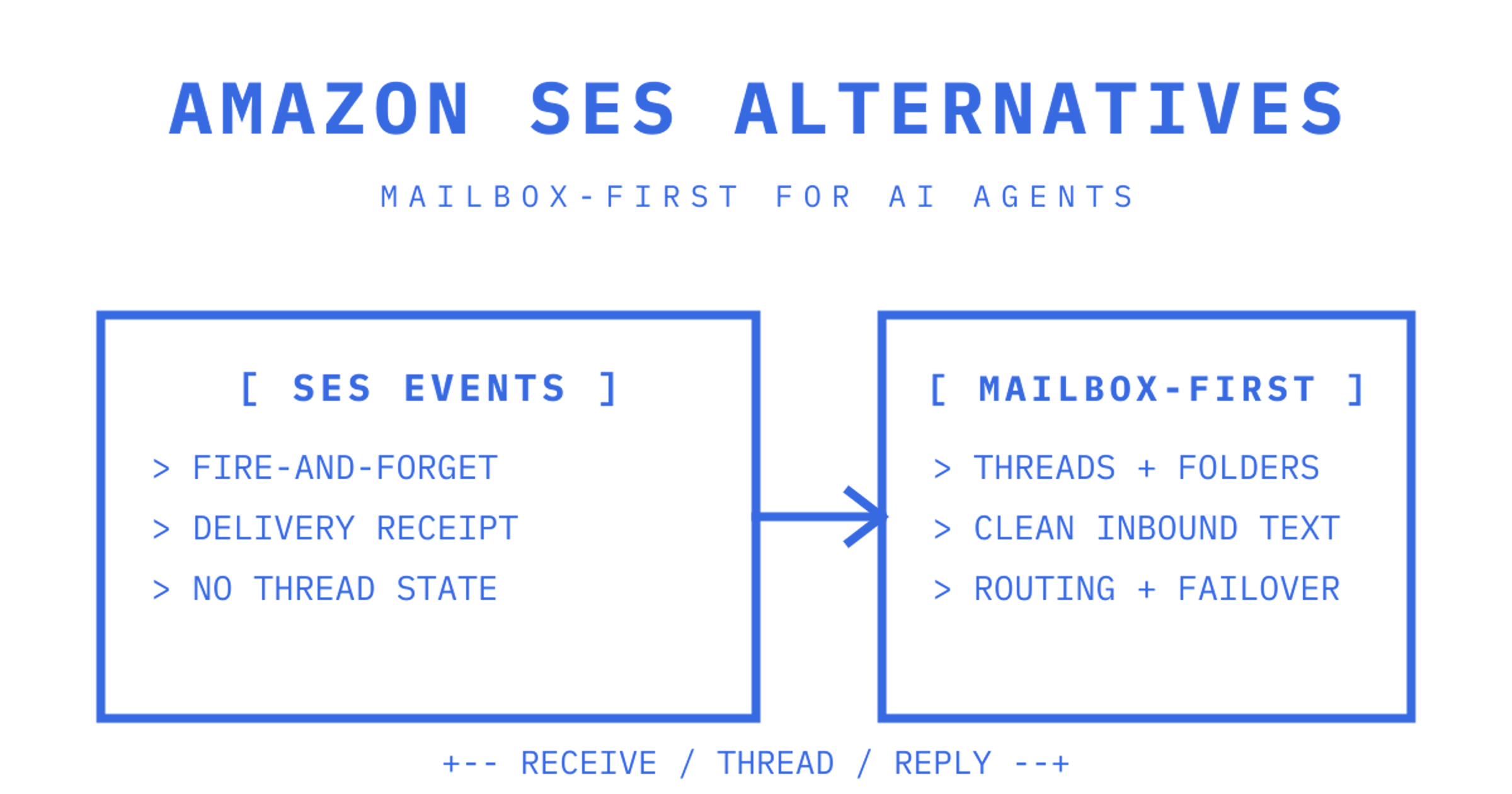
The right Amazon SES alternative for AI-agent workloads is a mailbox-first platform, not another send-only ESP. If your agents need to receive, thread, and reply to email, not just blast it out, you need persistent mailboxes with cleaned inbound text and multi-provider outbound routing. Sendmux fits that brief. The checklist, buying criteria, and migration steps below explain why.
Why agents outgrow send-only Amazon SES
A send-only provider treats email as a fire-and-forget event: you post a message, you get a delivery receipt, and that's the relationship. Amazon SES, and the classic SMTP relays it competes with, were built for exactly that job. They're excellent at it. They're also the wrong abstraction for an agent that needs to hold a conversation over email.
Mailbox-first means the platform gives every agent, tenant, or workspace a persistent inbox with real state: threads that accumulate over weeks, folders, keywords, and a message history the agent can query instead of re-parsing from scratch. Sendmux's Mailbox API is built around exactly this, returning quote-stripped, cleaned message text alongside raw MIME so an agent reasons about the new reply, not the entire thread history buried in a quoted block.
That distinction matters practically:
- Send-only providers hand you a webhook with raw metadata; you build your own parser, thread-matcher, and storage layer.
- Mailbox-first platforms give you threads, folders, and cleaned text natively, so agents get structured objects instead of MIME soup.
- Token cost compounds fast when an agent re-reads quoted history on every reply; cleaned text keeps prompts lean.
- Inbound events arrive as SSE streams or signed webhooks, not just delivery confirmations.
If your product needs agents that read replies, follow up, and route conversations, a sending-only replacement for SES solves half the problem at best.
What capabilities should you actually require?
Vendor docs and demos tend to blur the line between "supports email" and "supports agent mailboxes properly." Run every alternative through this checklist before you commit engineering time.
- Mailbox fundamentals: persistent threads (with
in_reply_to/referencesheaders), folders, keywords, and defined attachment and storage limits, not a vague "we support attachments."
- Inbound event delivery: does it offer both a Server-Sent Events stream and HMAC-signed webhooks with retry and backoff? Event types should cover delivered, bounced, complained, rejected, delayed, and received/spam-received, not just "message received."
- Outbound routing: can you bring your own providers (Gmail OAuth, Microsoft 365, custom SMTP) and set distribution percentages, per-provider quotas, and automatic failover when an account starts failing?
- Security and governance: scoped credentials that separate send from receive, mailbox-level tokens rather than one team-wide key, and the ability to suspend a single mailbox across every channel at once. Microsoft's own agent identity governance guidance makes the same point for enterprise identity: agent identities need governed, scoped access with oversight across their lifecycle.
- Developer tooling: an OpenAPI spec, SDKs in the languages your team actually uses, a CLI for scripting, and increasingly, MCP or A2A support so agents can self-serve without a human wiring up OAuth by hand.
- Observability: exportable delivery logs, bounce and complaint rate tracking, and per-provider health snapshots. Silent routing failures are the hardest bugs to catch after launch, and without CSV export and provider health data, you're debugging blind.
How do you choose between competing platforms?
Rank the checklist above by what actually breaks production, not by what's easiest to demo. Inbound fidelity and routing control matter more than a polished dashboard, because a platform that mangles thread structure or silently drops a failing provider will cost you weeks of debugging later.
Ask vendors these questions directly, and note who answers with specifics versus generalities:
- What does a cleaned inbound payload actually look like, and is raw MIME still available if I need it?
- How are webhooks signed, and what's the retry policy if my endpoint is briefly down?
- Can I scope a credential to one mailbox with only receive permission, or is it all-or-nothing?
- What happens automatically when one of my connected sending providers starts failing? Does routing skip it, or do messages queue silently?
- Can I import and export accounts and mailbox data without touching raw secrets?
Treat these as red flags: no cleaned-text option (you'll burn tokens parsing MIME yourself), pricing that charges per mailbox regardless of message volume (punishing for high-mailbox, low-volume architectures), and no replayable event history if a webhook endpoint goes down mid-launch.
For a proof of concept, score success on three things: whether cleaned text and threading survive a real conversation intact, whether a simulated provider failure actually triggers failover, and whether delivery metrics update in near real time rather than after a batch job. If a platform passes those three tests, the rest of the evaluation is mostly detail. Practitioner guidance backs the priority order here: governed, scoped credentials limit the blast radius of a leaked key or a misbehaving agent in a way broad, unscoped API keys cannot.
Migration and test checklist for a safe proof of concept
Don't point a new platform at production traffic on day one. A staged rollout protects your sending reputation and gives you a fair comparison against your current SES setup.
- Spin up an isolated test team with its own scoped keys, separate from anything touching production mailboxes.
- Use sandbox mailboxes where the platform offers them, so early testing never risks real sender reputation.
- Import or simulate a representative slice of inbound traffic, then check that threading and cleaned text hold up against messy real-world MIME, forwarded chains, and quoted replies.
- Run small-volume outbound tests across each connected provider, watching bounce and complaint rates closely rather than trusting a "delivered" status alone.
- Verify agent behaviour against cleaned payloads, confirming attachments resolve through working short-lived download links rather than breaking silently.
- Set rollback thresholds before you start, not after something goes wrong: a bounce rate above 5% or a complaint rate above 0.1% should trigger an automatic pause. The bounce handling guide shows how to track bounce and complaint outcomes by provider, sending account and stream before you cut over.
Run this over days, not hours. Reputation damage from a rushed migration takes far longer to repair than the migration itself.
Why this category matters for AI-driven product teams
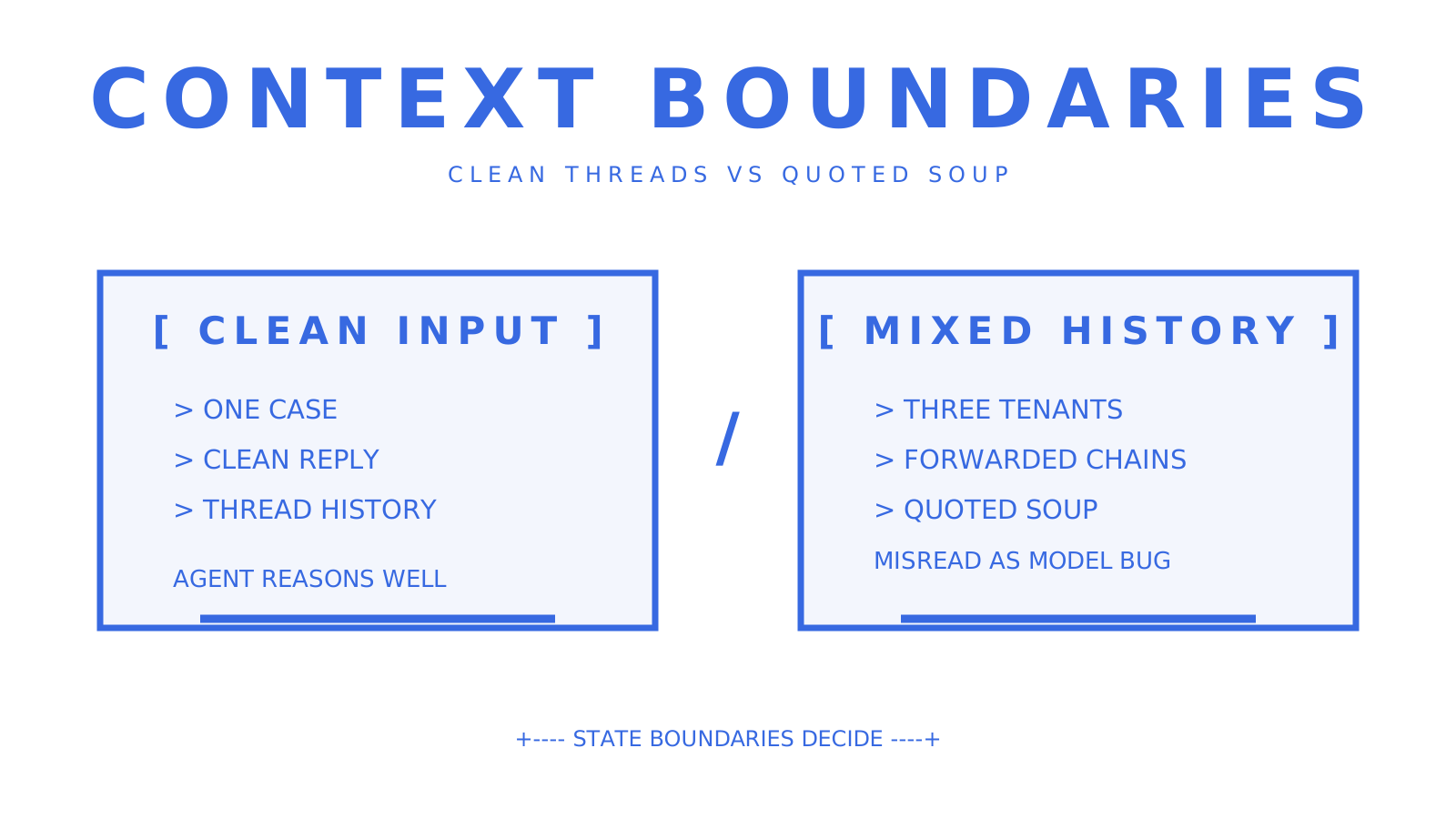
Most teams underestimate how much agent reliability depends on context boundaries, not model quality. An agent that receives a clean, correctly threaded message about one customer's case reasons well. An agent parsing quoted history across three forwarded emails from different tenants reasons badly, and the failure gets misread as a model problem while the real cause is data plumbing.
Governance at the API level, not just at the model layer, is what prevents a single compromised or misbehaving agent from damaging your entire sending reputation. Scoped credentials and per-mailbox suspension aren't bureaucratic overhead here. They're the mechanism that contains a bad actor or bad prompt to one mailbox instead of one domain. Bring-your-own routing extends that logic outward: your deliverability stays yours, spread across providers you control, instead of pooled with strangers on someone else's shared IP range.
Sendmux: mapping the checklist to a real proof of concept
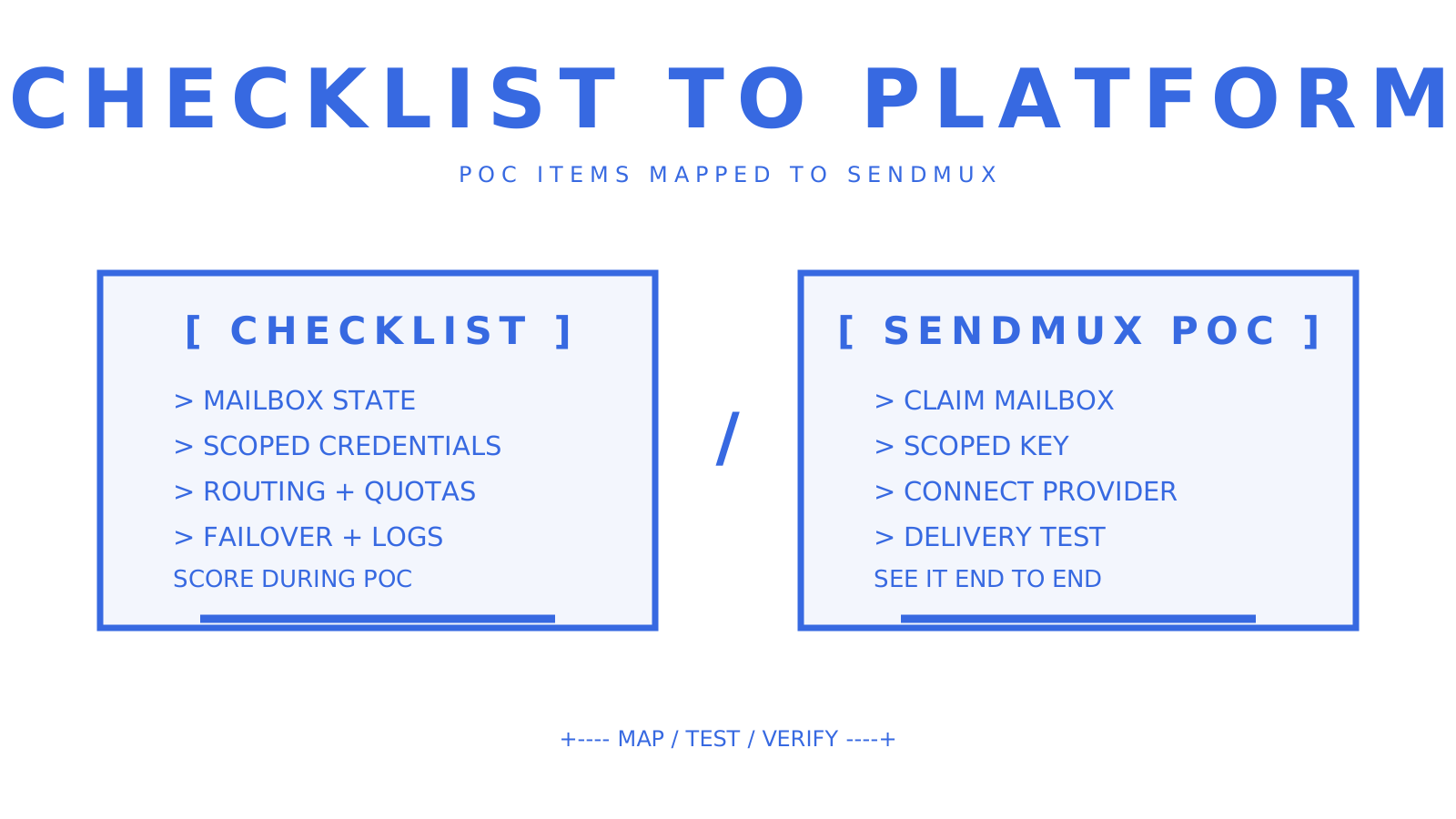
Sendmux is built specifically for the mailbox-first case this article has been describing, not retrofitted onto a send-only foundation. Every checklist item above maps to a real feature: the Mailbox API handles threads, folders, and cleaned text; outbound routing lets you connect your own Gmail, Microsoft 365, or SMTP accounts with quotas and automatic failover; scoped mailbox keys and agent tokens keep permissions tight; and SDKs across TypeScript, Python, Go, PHP, Ruby, and Rust, plus MCP support for agent builders, mean you're not writing glue code from scratch.
Pricing follows usage rather than per-mailbox fees. The Free plan costs $0 per month and includes two mailboxes to test the mailbox API immediately. Pro runs $7 per month per team plus usage charges of $0.000500 per provider-accepted outbound recipient through your own connected provider, $0.000500 per inbound mailbox delivery, and $0.02 per GB of storage monthly. Enterprise is priced on contract for teams that need dedicated infrastructure.
To start a proof of concept: claim a free mailbox, generate a scoped mailbox key, connect one sending provider, and run a real delivery test end to end. You'll see threading, cleaned text, and routing behaviour first-hand, not after a sales cycle.
Authoritative links and docs
For deeper reading on the governance and architecture points raised here: Microsoft's agent identity governance overview covers API-level oversight for automated identities, Sendmux's product site introduces the mailbox-first feature set, and the pricing page breaks down plan tiers and usage billing. For broader context on where AI-driven efficiency gains show up across workflows, see this analysis of AI's productivity impact for agencies.
Frequently Asked Questions
What's the difference between Amazon SES and a mailbox-first alternative?
Amazon SES sends and receives email as discrete events with no persistent state; a mailbox-first platform like Sendmux gives every agent a real, threaded inbox that holds conversation history. If your agents only need to send transactional email, SES-style sending suffices; if they need to receive and reply intelligently, you need mailbox persistence.
Is a mailbox-first platform more expensive than Amazon SES?
It depends on usage pattern, not just per-message pricing. Sendmux bills $0.000500 per provider-accepted outbound recipient and $0.000500 per distinct inbound mailbox delivery, with the Pro plan at $7 per month per team, which tends to undercut per-mailbox pricing models when you're running many low-volume mailboxes.
Can I keep using my existing Amazon SES account with a mailbox-first platform?
Yes. Sendmux supports bring-your-own outbound routing, so you can connect an existing Amazon SES account alongside Gmail, Microsoft 365, or custom SMTP providers and route sends across them with quotas and failover.
What should I test first in a proof of concept?
Test inbound fidelity first: send a real conversation thread through the platform and confirm cleaned text, correct threading, and attachment handling survive intact before testing outbound volume or routing failover.
Do mailbox-first platforms support AI agent frameworks directly?
Increasingly yes. Sendmux exposes an MCP endpoint and SDKs across several languages, letting agent frameworks connect to mailbox and sending functions without custom integration work for each provider.
