Best Email API for Go: Five Options Compared (2026)

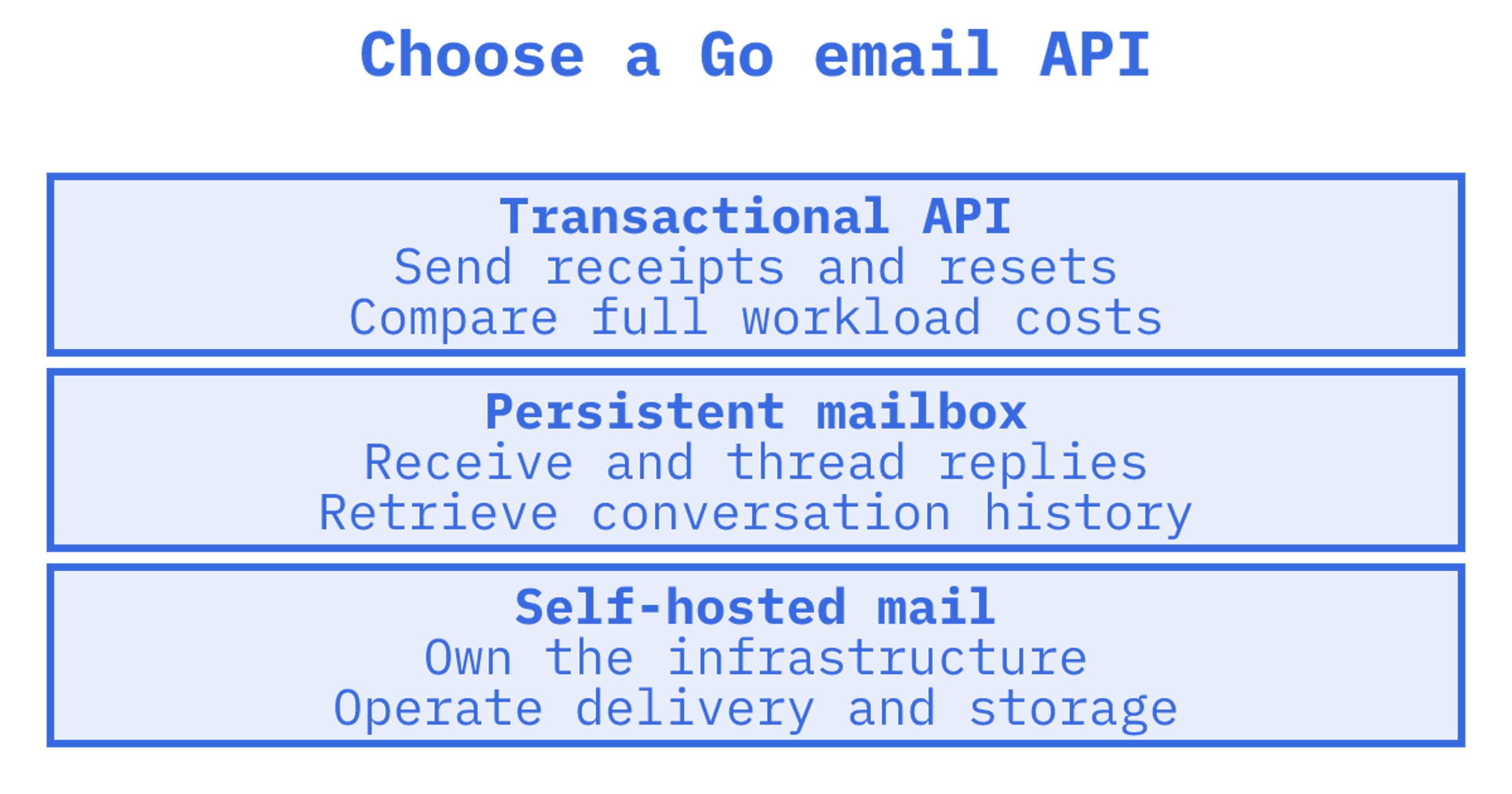
A Go service sending password resets has a different shopping list from an agent that reads replies. For receipts and resets, a clean REST API and a typed client will do. Reply handling takes more: real mailboxes that hold conversations, thread responses and hand them to your agent. That narrows the field quickly. We compare the realistic routes for Go teams here, including our own, and explain where we'd use each one.
TL;DR
- You can call a REST email API from Go with
net/httpand acontext.Contextdeadline. A special SDK is optional. Compare providers on inbound mail, webhooks, logs and pricing.
- For one-way transactional mail, price a dedicated sending provider alongside Amazon SES. Use your expected volume and include the cost of operating the integration.
- We'd start with persistent mailboxes and threading for agents that read and reply to email. That's what Sendmux is built for.
- Self-hosting puts you in control. Your team also takes on deliverability, abuse handling and storage.
- Follow the provider's documented signature scheme to verify webhooks. Make handlers idempotent so a repeated event doesn't repeat the work.
Table of Contents
1. What a Go service actually needs from an email API
We'd choose a Go email API by looking at the jobs the service must handle. A receipt needs sending. Reply processing and a tenant's conversation history make different demands on the platform.
Sending model. Go services can have many goroutines sharing a client that makes one REST call per message. Check batch support and idempotency keys, then look at what happens when the provider rate-limits a request. Predictable retries matter. A long feature list won't tell you whether a sending call behaves sensibly under that load or how much retry logic your service needs around it.
Inbound. Find out what arrives: cleaned reply text, or raw MIME for your service to parse. An agent answering a customer needs to tell the new question apart from the quoted conversation below it.
State. A webhook delivers an event. A persistent mailbox keeps history that an agent can retrieve through an API when it needs to search earlier replies or sync changes.
Observability. At 2 am, a missing message sends you to the logs. Check that you can trace delivery, bounces and suppressions, along with the webhook retry history.
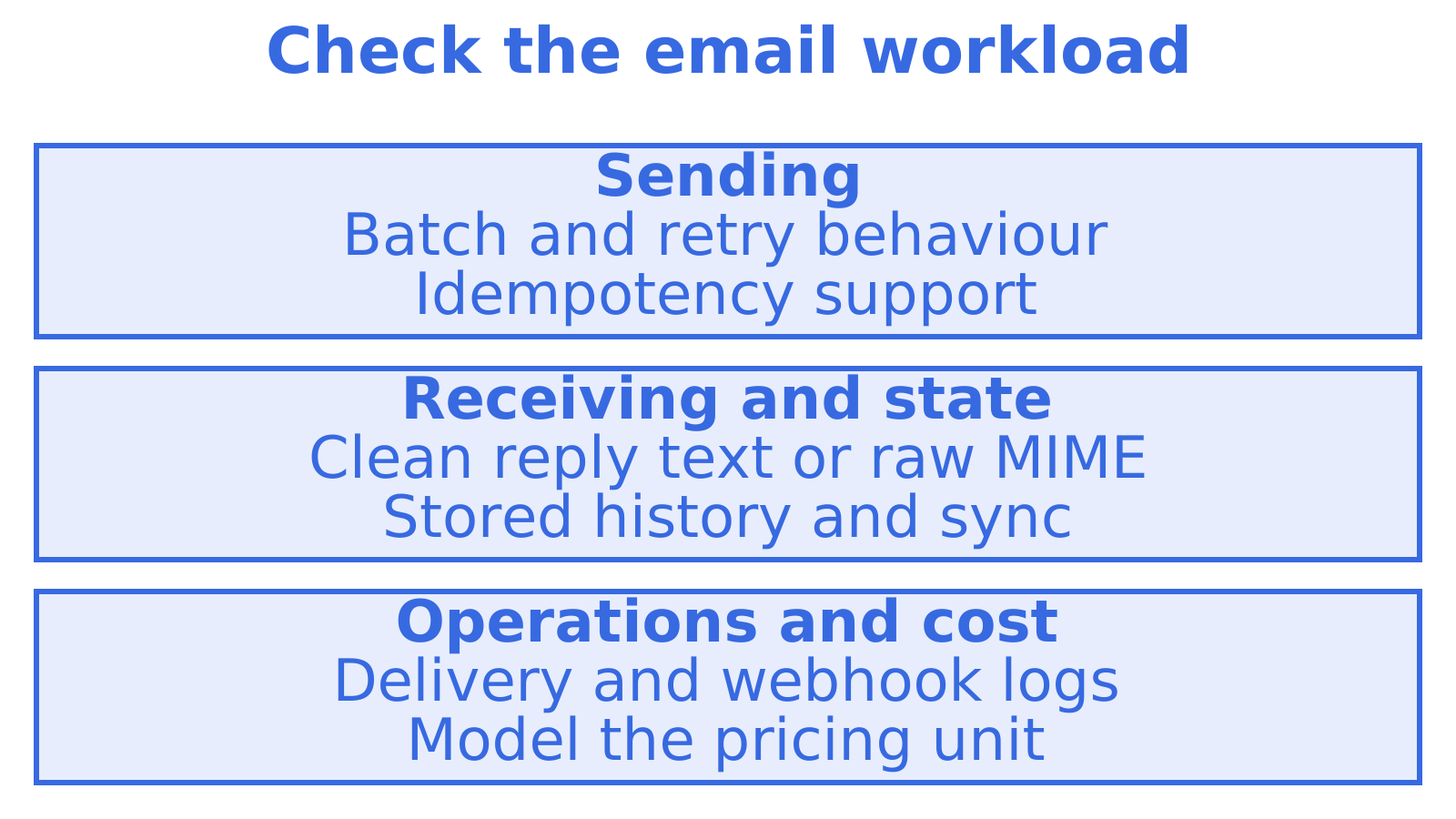
Pricing shape. Work out what grows the bill: messages, seats, connected accounts or inboxes. Price a tenant sending one receipt, then one storing a long conversation. A headline rate won't explain both.
2. The five routes at a glance
| Route | Best for | Inbound mail | Persistent mailboxes | Main trade-off |
|---|---|---|---|---|
| Sendmux | Agents, multi-tenant products, outbound across several providers | Yes, cleaned text and threading | Yes, per agent or tenant | Broader than a pure transactional sender |
| Transactional sending API (Postmark, Resend, Mailgun and similar) | Receipts, alerts, password resets | Varies by provider | No | You add a parser and a mailbox layer if you need replies |
| Amazon SES | High volume at the lowest unit cost | Possible, but you assemble it | No | More AWS plumbing and your own tooling |
| Inbound-first Go SDK platforms | Webhook-driven inbound processing | Yes | Limited | Smaller developer communities, check maturity |
| Self-hosted (go-mail, Posta) | Strict infrastructure ownership | You build or host it | You build it | You own deliverability and operations |
Shortlist routes from the table. Before committing, check each provider's current documentation against the work your service needs to do.
3. Sendmux: mailboxes and multi-provider sending in one API
Sendmux is the email API for AI agents. Each agent, customer, workspace or tenant gets a real mailbox with a real address, either on the included @myagent.mx domain or on a custom domain verified for receiving. You send, receive, thread, route and log mail through one API, rather than combining a sending provider, a Gmail OAuth workaround, a parser and a webhook relay.
For a Go developer the useful parts are practical:
- A mailbox is persistent state. The Mailbox API covers messages, threads, folders, keywords, attachments, sender identities, quotas, usage and submissions.
- Agents read cleaned text. Quoted history is stripped, so your code acts on the new reply without walking a raw MIME thread. Raw body endpoints remain when you need the exact original.
- Retrieval stays cheap.
GET /mailbox/messagesfilters on folder, thread, free-text query, sender, recipient, subject, headers, size, keywords, date range, attachments and unread status. A count endpoint answers "how many" without returning rows, and search-snippets returns previews without pulling whole bodies. That keeps payloads, and token bills, small.
- Sync with state tokens. Sync endpoints return state tokens, so you ask for typed changes to a mailbox, folder or query rather than re-listing the inbox.
- Bring your own providers. Add Gmail, Outlook or custom SMTP accounts and route sending through authorised delivery groups. See the email sending API with automatic failover for the detail.
It is all plain HTTP, so a Go client is a thin wrapper around http.Client with typed structs for the responses you use. Access also comes through MCP and a CLI, which helps when the same mailbox is used by a coding agent in your terminal and by your Go service in production.
A Go service sending a few hundred password resets a month gets little benefit from persistent conversation history. We'd compare pure sending providers first for that job.
What it costs
Pricing is usage-based and published on the Sendmux pricing page. The Free plan is 0 USD per month per team and Pro is 7 USD per month per team; Enterprise has no published price. Usage fees are:
| Item | Rate |
|---|---|
| Connected outbound (your own providers) | 0.000500 USD per provider-accepted recipient occurrence |
| Managed sending | 0.000750 USD per provider-accepted recipient occurrence |
| Inbound | 0.000500 USD per distinct mailbox delivery |
| Storage | 0.02 USD per decimal GB-month |
4. Transactional sending APIs: the default for one-way mail
Go tutorials regularly reach for Postmark, Resend, Mailgun, SendGrid and Mailjet. There's a reason. These providers give you a REST endpoint, usually an official or community Go client, reasonable deliverability tooling and a dashboard where you can inspect logs. Reviews such as the EmailToolTester roundup tend to rank them on deliverability and price.
The gap shows up when your product starts to listen. Inbound features differ widely, and almost none give you a persistent mailbox your agent can search, thread and sync. You end up adding a parser, a store and a webhook relay, which is the stack we built Sendmux to replace. Our own guide to the best email API for developers covers that comparison in more depth.
Choose this route when outbound mail is the main requirement and a provider's delivery tooling and pricing fit your workload.
5. Amazon SES: lowest unit cost, most assembly
At high volume, SES deserves a look because the per-message rate can drive a large part of the bill. AWS publishes a Go SDK. Add dedicated IPs, deliverability tooling and data transfer to the estimate, along with engineering time, before deciding whether SES is your cheapest route.
With SES, you'll also need to configure suppression handling and connect inbound processing through AWS services. Conversation history needs a home too. We'd consider this route for a team already comfortable operating those pieces in AWS.
6. Inbound-first and agent-first Go SDK platforms
Inbound's Go SDK covers sending and inbound webhook processing. Sendara's Go client covers transactional and marketing workflows, while Dead Simple Email and Primitive also address agent or inbound use cases. Compare the actual receiving workflow in each platform; a Go SDK alone doesn't tell you where messages persist.
A Go-native client with webhook-first inbound may suit your service. Before committing, check the project's maintenance history and SDK versioning. Is the SDK stable? Then establish whether messages stay in a mailbox or the platform only forwards events, because those leave an agent with very different foundations for retrieving its conversation history. Our Go email API guide covers four ways to send and receive mail from Go with that distinction in mind.
7. Self-hosting: control at an operational price
Teams that must own their infrastructure have Go building blocks to work with. The go-mail module provides SMTP and ESMTP clients and servers, plus DKIM and POP3 support. Its IMAP support is described as incomplete or beta. Posta takes the self-hosted HTTP platform route, handling SMTP delivery, templates, storage and analytics as an alternative to hosted services.
Self-hosting makes your team responsible for IP reputation and abuse prevention. You'll maintain DKIM and DMARC, storage, monitoring and security patches too. Infrastructure ownership may justify the work. If you're comparing costs, put on-call hours and incident recovery in the estimate alongside the server bill.
8. Go-specific patterns that apply to any provider
Before increasing traffic, we'd build the paths for slow responses, uncertain send results and repeated webhook events into the Go service.
- Pass a context on every call. Use
context.WithTimeoutto set a deadline and attach the context to the request. A slow provider shouldn't leave the call waiting indefinitely.
- Check idempotency before retrying sends. A network timeout can leave you unsure whether the provider accepted a customer's invoice. Where the provider supports idempotency, reuse the same key on the retry.
- Verify webhook signatures before parsing. If the provider uses HMAC to sign the raw body, read it with
io.ReadAlland verify those exact bytes before unmarshalling. Re-encoding JSON can change the signed bytes.
- Acknowledge fast, process later. Queue the work and return a 2xx quickly. Providers retry slow or failed deliveries, so make handlers idempotent and deduplicate by message ID or event ID. The Dead Simple Go SDK documentation describes the same discipline.
- Act on bounces and complaints. Update suppression records when they arrive. Check those records before sending again.
- Keep keys out of code. Store keys in a secrets manager, rotate them and choose the narrowest scopes the provider supports. A credential that sends mail in your customer's name deserves care. These API key management practices help limit the damage.
Use our developer guide to sending email via API for the sending request. To set up receiving, start with inbound email API setup in five steps.
9. Our perspective: the send endpoint is the easy half
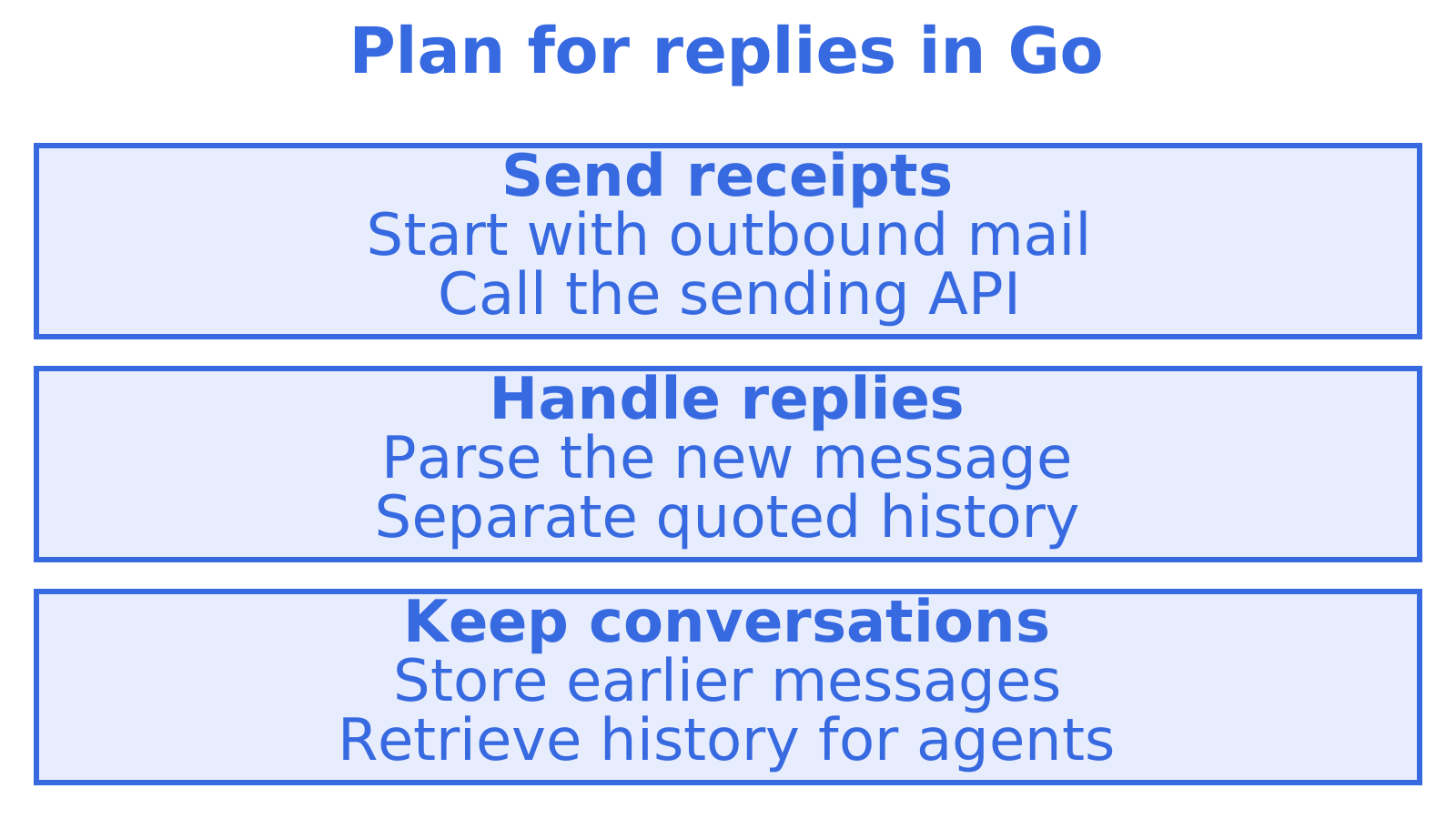
Imagine a Go service sending outbound receipts. Customers start replying, and the team adds a parser. An agent needs earlier conversations, which means adding storage. Recovery logic follows when a Gmail OAuth token expires. Each addition is manageable. Together, though, they create a workload that belongs in the original API comparison.
Our view is that for agent workloads, the mailbox should be the unit of design, not the message. An agent with its own address, its own quota, its own logs and its own threaded history behaves predictably, and a tenant boundary becomes a mailbox boundary you can reason about. Multi-provider routing belongs in the same layer, because failover is far easier when the platform already knows each provider's quota and health.
We also think the cost of an agent is increasingly its context window. That is why cleaned message text, snippets and counts matter: the cheapest token is the one you never send to the model.
For a Go service that sends only one-way alerts, pick the simplest sender you trust. A product that reads replies and routes mail should start with the mailbox. Sendmux suits that broader workload.
10. How to choose in ten minutes
Answer these in order and stop at the first yes.
- Must everything run on your own servers? Look at self-hosting and include the team's operating time in the assessment.
- Is your mail strictly outbound and transactional? Price a dedicated sending provider alongside SES for the full workload.
- Will you need replies, threads or per-tenant inboxes? Look at platforms with persistent mailboxes.
- Do you need routing across Gmail, Outlook or SES accounts you already hold? Check the platform's supported providers, quota handling and failover behaviour.
If you land on 3 or 4, you can try Sendmux on the Free plan with 1 USD in usage credit and move to Pro at 7 USD per month per team plus usage when you need more. Start from the Sendmux pricing page, or look at inbound mailboxes first. If your agent runs in an AI client, the MCP option lets it read and send mail without custom glue.
Sources
Recommended
Frequently Asked Questions
Do I need a Go SDK to use an email API?
No. You can call any REST email API from Go with `net/http` and `encoding/json`. Typed structs for the fields you use are enough. An official SDK can save work on retries and pagination, but you can use the API without one. Sendmux uses REST, so a thin wrapper will do.
What is the best email API for Go if I only send transactional mail?
For one-way receipts and alerts, we'd price a dedicated transactional provider alongside Amazon SES. Check current prices and delivery tooling. Include the work your team will operate too. Add persistent mailboxes to the comparison when the product needs conversation history or must receive and thread replies.
Can I receive email in a Go application without running a mail server?
Yes. A hosted platform receives mail for your Go application and makes it available through an API or webhook. Sendmux keeps each mailbox, so your code can fetch cleaned message text, search messages and sync changes. Quoted history is stripped. When you need the original MIME, use the raw body endpoints.
Is self-hosting email in Go worth it?
It can be, if infrastructure ownership justifies the operating work. Libraries such as go-mail and platforms such as Posta supply the building blocks. Your team handles deliverability and reputation, along with abuse prevention and upgrades. We'd put server costs, on-call hours and maintenance time beside the hosted API bill for your expected workload.
