Choose by SDK Ergonomics: AI Inbx Alternatives for Developers

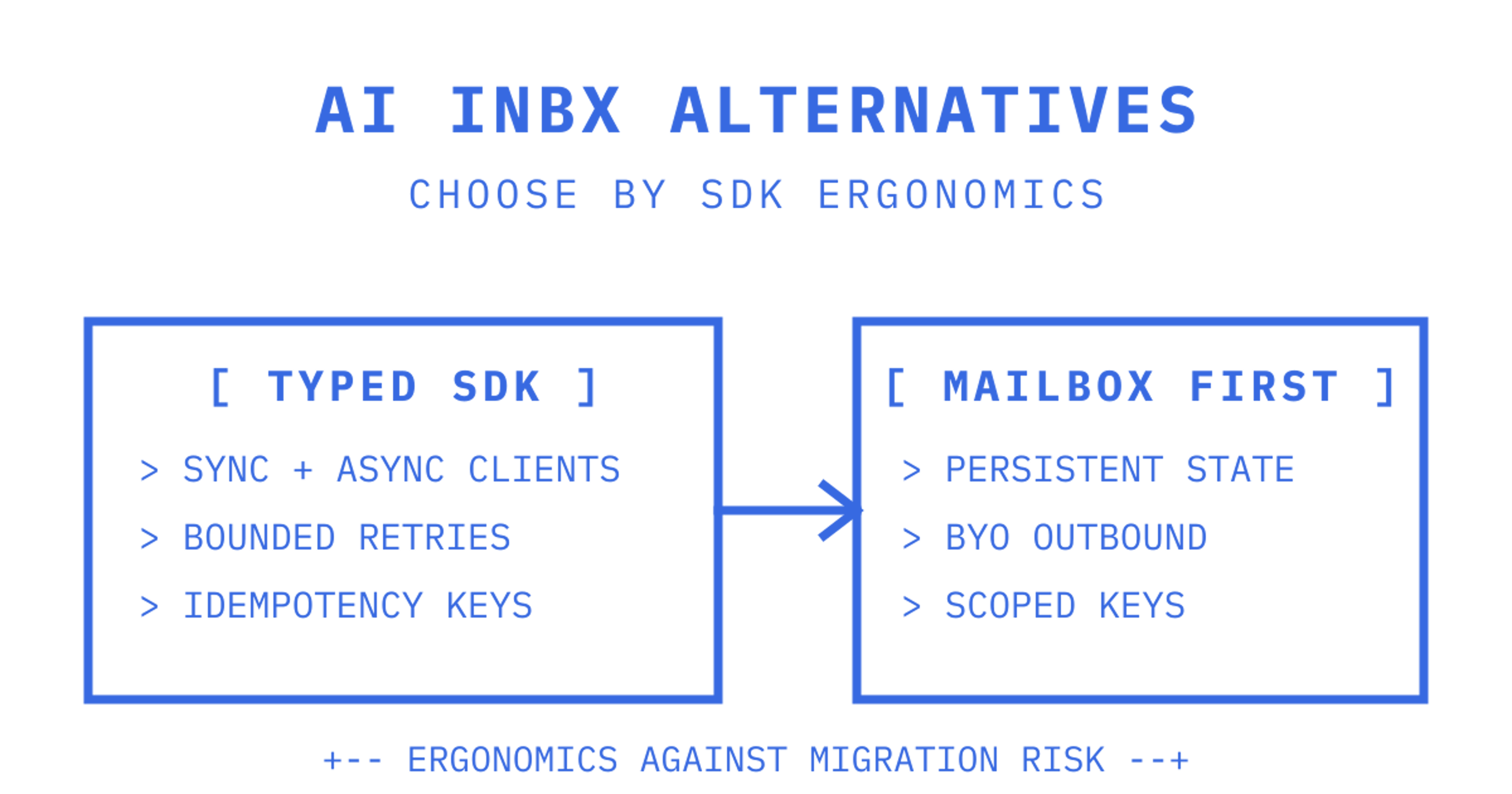
The two practical alternatives worth evaluating are Sendmux and AI Inbx, and for most agent-scale, mailbox-first workloads, Sendmux is the stronger fit. For broader market context, see Toolsolved.com alternatives for agencies, which discusses adjacent automation tooling. The decision comes down to one axis: developer ergonomics against migration risk. Sendmux gives agents persistent mailbox state and bring-your-own sending across providers, while AI Inbx leans on typed SDKs across a broad workflow surface.
Comparing the alternatives on developer-facing dimensions
Both platforms solve the same underlying problem: giving an AI agent a real inbox it can send from, receive into, and reason over without a human babysitting OAuth tokens. The similarity ends at architecture.
Sendmux treats a mailbox as persistent state rather than a webhook drop. Messages, threads, folders and attachments live behind a Mailbox API with filtering, batch operations and sync endpoints that return state tokens instead of forcing a full re-list. Inbound delivery reaches an agent through signed HMAC-SHA256 webhooks or a Server-Sent Events stream, and outbound sending routes through Gmail OAuth, Microsoft 365, custom SMTP or a managed Amazon SES account, with delivery groups and provider health checks deciding where a message goes.
AI Inbx takes a different route. Its Python SDK is typed, with synchronous and asynchronous clients, bounded retries that respect Retry-After, per-request timeouts and idempotency keys built in. The resource surface is broad: spaces, mailboxes, threads, domains, OAuth apps, webhooks, suppressions and pacing rules, all documented as a single lifecycle rather than a send-first API with extras bolted on. The aiinbx-py client on GitHub supports both httpx and aiohttp backends, so teams running high-concurrency agent fleets can pick whichever async runtime fits their stack, and it ships an MCP server for testing endpoints directly.
| Dimension | Sendmux | AI Inbx |
|---|---|---|
| SDK ergonomics | Typed clients in TypeScript, Python, Go, PHP, Ruby, Rust | Typed sync/async Python client, httpx or aiohttp backend |
| Mailbox/workflow surface | Persistent mailboxes, threads, folders, parsed body plus raw MIME | Mailboxes, threads, spaces, domains, OAuth apps, pacing rules |
| Webhook/event reliability | Signed HMAC-SHA256 webhooks, SSE stream, 7-day retry diagnostics | Signed webhook verification, documented retry semantics |
| Credentials and scoping | Scoped mailbox keys, agent tokens, infrastructure keys | Idempotency keys, per-request auth documented in SDK |
| Outbound routing / BYO sending | Gmail, Outlook, custom SMTP, managed Amazon SES, delivery groups | Not the SDK's stated focus |
| Developer tooling | OpenAPI 3.1, six SDKs, CLI, MCP, A2A protocol | Typed SDK, MCP server for endpoint testing |
| Pricing shape | Usage-based, no per-mailbox fee on Free or Pro | Not published in the SDK docs |
A few migration risks deserve attention before you commit to either path:
- A platform that only returns raw MIME forces your agent to parse quoted history itself, which inflates token usage and complicates threading logic.
- Missing signed webhooks mean you are trusting unauthenticated payloads, a real problem once a mailbox handles anything beyond test traffic.
- No mailbox persistence means every inbound event is stateless, so search, folder logic and thread continuity have to be rebuilt in your own database.
How to evaluate and pick a replacement for AI Inbx
Picking a replacement is less about feature lists and more about what breaks when you flip the switch. Run the evaluation against concrete criteria, not marketing copy.
- Confirm SDK parity. Check that the alternative ships typed clients for your language, with both synchronous and asynchronous support if your agents run concurrent workloads.
- Verify webhook signing. Test that signature verification (HMAC or equivalent) works against your own payloads before trusting production traffic.
- Test idempotency behaviour. Send the same request twice with an idempotency key and confirm no duplicate message goes out.
- Check thread continuity. Reply to a message and confirm
in_reply_toandreferencesheaders carry through correctly on both sides.
- Validate parsed body availability. Confirm the API strips quoted history from the cleaned body while still exposing the raw MIME when you need it.
- Exercise attachment handling. Send and receive a file above a few megabytes and confirm the size limits match what your agents will actually send.
- Check storage and quota behaviour. Fill a mailbox close to its quota and confirm the API degrades predictably rather than silently dropping mail.
- Confirm SSE availability. If you cannot host a public webhook endpoint, verify the SSE stream delivers the same events with acceptable latency.
Pro Tip: Run a failed-delivery retry test deliberately, by pointing a webhook at a dead endpoint, to see how many attempts you get and how long diagnostics stay available before you commit production traffic.
Red flags that should stop a migration outright: no documented retry semantics, no signed webhook verification, or a mailbox model that cannot survive a restart without losing thread history.
What logs, metrics and delivery events tell you before launch
Delivery visibility is where most migrations quietly fail, because the failure mode is not a crash, it is silence. You send a message, nothing bounces, and three days later a customer says they never got it.
Sendmux records statuses per message including pending, sent, failed or rejected, along with sender, recipient, provider and attempt count details, with filtering and CSV export capabilities. Bounce, complaint and delay outcomes arrive as webhook events rather than log rows, and the Management API exposes metrics and delivery logs you can query by message status. The dashboard includes bounce and complaint rates plus a reputation snapshot related to the managed Amazon SES account.
AI Inbx's SDK documentation centres on retry semantics and error handling at the client layer rather than a dashboard-level metrics surface, which means teams evaluating it should confirm what delivery-level reporting exists outside the SDK before assuming parity. When you compare alternatives on this axis, ask a specific question: can you answer "how many messages failed in the last 24 hours, and why" without writing your own log aggregation.
Support and community resources for each alternative
Support quality rarely shows up until something breaks in production at 2am, so it pays to know where you would actually go for help before you need it.
AI Inbx's primary support surface is its SDK documentation and the public GitHub repository, where issues and pull requests give a direct line to how actively the client is maintained. That is a reasonable signal for a typed SDK: you can read the commit history and see how quickly bugs get triaged.
Sendmux documents its API surface through OpenAPI 3.1 specifications, guides covering mailbox provisioning and webhook reliability, and a status page tracking uptime. Discovery manifests and an agent-skills index also mean an agent itself can pull documentation without a human digging through a support portal, which matters more as fleets scale past a handful of mailboxes per team.
Neither platform lists a large public community forum, so for both, the practical support channel during evaluation is the documentation itself plus whatever direct contact each vendor offers.
Integration compatibility with popular frameworks and platforms
Framework fit decides how much glue code you write, and it is worth checking before you assume an SDK "just works" with your stack.
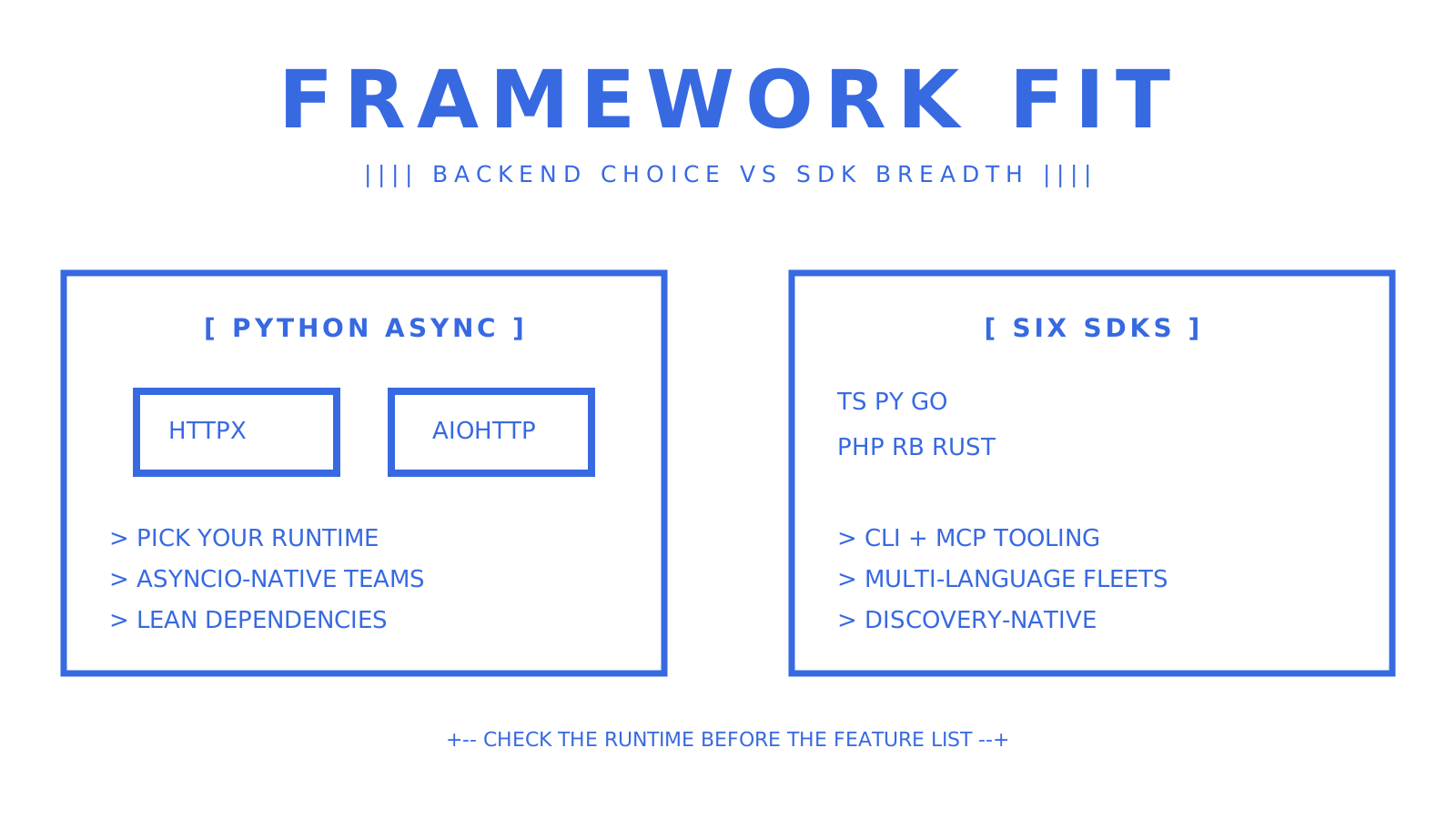
AI Inbx's Python client supports both httpx and aiohttp as HTTP backends, which gives you a choice depending on whether your agents run inside an asyncio event loop already tuned for one or the other. That flexibility matters for teams running high-concurrency agent fleets where the wrong backend can bottleneck throughput.
Sendmux ships SDKs across TypeScript, Python, Go, PHP, Ruby and Rust, plus a CLI covering all three of its API surfaces and a Model Context Protocol server with documented setup for clients including Claude, Claude Code, ChatGPT, Cursor and Copilot. An Agent Skills pack installs directly into agent frameworks with npx skills add Sendmux/skills.
If your stack is Python-only and you are optimising for a lean dependency footprint, that narrows the field. If you are running agents across multiple languages or need MCP-native discovery, the breadth of SDK coverage becomes the deciding factor.
Security and compliance features of alternatives
Security posture is one of the harder things to compare fairly, because vendors describe it differently and neither of these platforms publishes formal certifications like SOC 2 or ISO 27001.
AI Inbx's SDK documents signed webhook verification as a first-class feature, which lets you confirm a payload actually came from the platform before your agent acts on it. That is the baseline check any mailbox integration should pass.
Sendmux hashes API keys with SHA-256 and never stores raw keys, encrypts provider credentials and OAuth tokens, and enforces TLS on every connection. Credential scoping runs three tiers deep: an infrastructure key with team-wide access, mailbox-scoped keys tied to explicit send, receive, read and update permissions, and agent tokens limited to granted scopes only. Domain verification runs through SPF, DKIM, DMARC and Amazon SES MAIL FROM records, with the dashboard exposing verification state directly.
Neither platform currently offers enterprise SSO or tenant-scoped audit logs, so if your compliance requirements include either, that is a gap to plan around rather than assume away.
Performance benchmarks and reliability data
Public benchmark numbers are thin across this category, and neither vendor publishes independent load-test results you can cite as an SLA.
AI Inbx's documentation describes retry behaviour, including bounded retries on network failures and a range of HTTP error codes, with respect for Retry-After headers. That is a design commitment to graceful degradation under transient failure, not a published throughput figure.
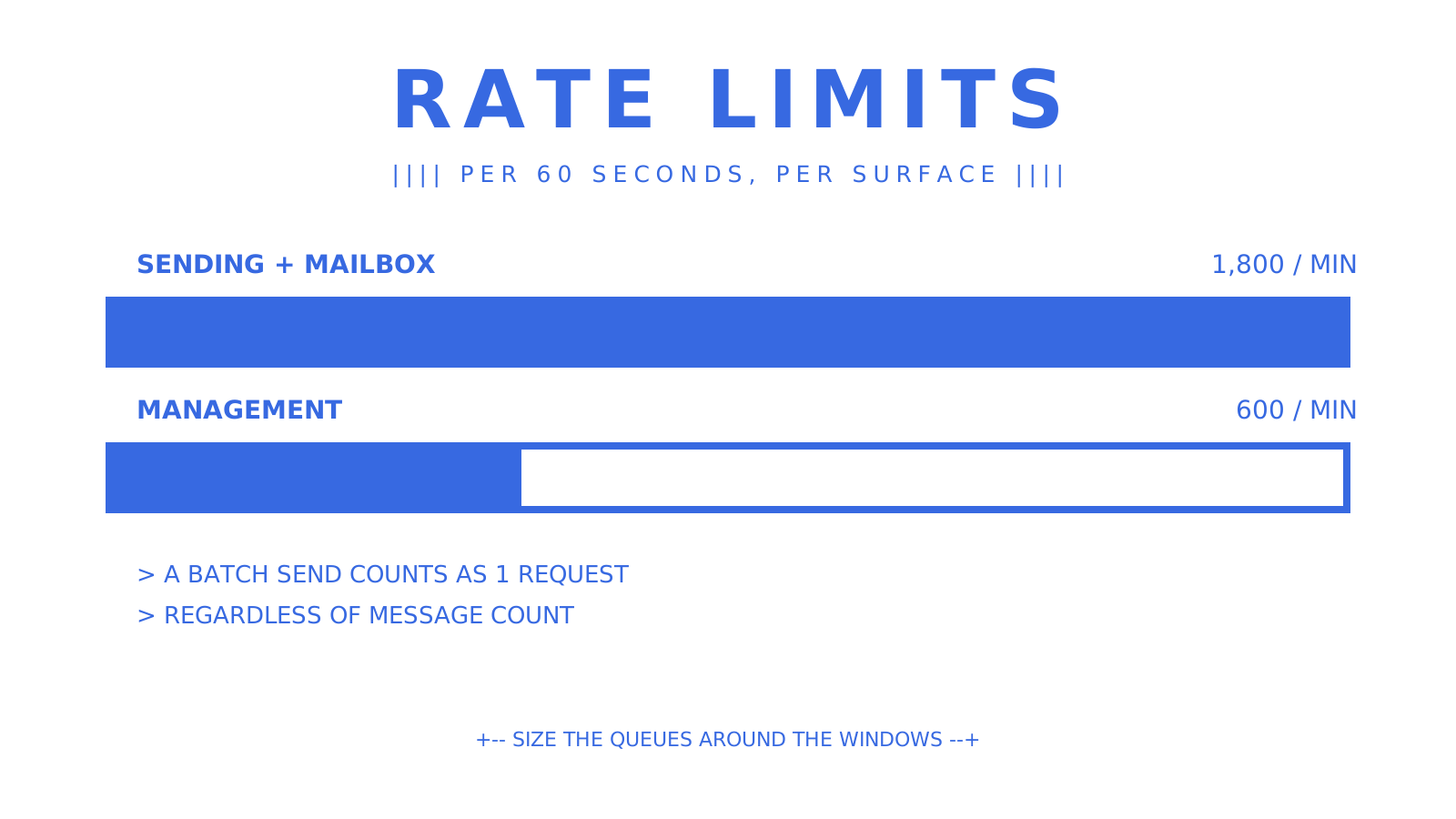
Sendmux's public capacity statements are its per-window rate caps and queueing behaviour rather than a published throughput figure. Rate limits sit at 1,800 requests per minute on the Sending and Mailbox APIs and 600 on the Management API, with a 100-message batch counting as a single request.
The honest takeaway for both: treat any capacity figure as a floor to validate yourself, not a promise to build your architecture around blind.
Trial and onboarding experience for each alternative
Onboarding friction compounds fast when you are trying to provision mailboxes for dozens or hundreds of agents rather than one test account.
AI Inbx's onboarding runs through its SDK: install the package from PyPI, point it at the documented base URL, and start working against the typed client. There is no separate dashboard step described in the SDK documentation itself, which suits a team that wants to stay in code from the first request.
Sendmux offers a Free plan with one team, two mailboxes and a starting credit that cannot be topped up, capped at 50 provider-accepted recipients per UTC day, which is enough to run every test in the evaluation checklist above without committing to a paid tier. Agents can also self-register without a human: discovery through a documented manifest, a constrained free mailbox, and an invitation to a human owner who approves send permissions before the agent gets a token that can actually send mail.
Whichever platform you trial, the fastest signal is a real send and receive cycle within the first hour, not a read of the pricing page.
Where developer ergonomics beat feature counts
Teams that pick an email API on feature-list length can regret it within a sprint, because the SDK's async support was an afterthought. Ergonomics and migration risk matter more than a longer resource list, and usage-based pricing with bring-your-own sending suits agent fleets whose mailbox count grows faster than their message volume.
Where to try Sendmux quickly
Sendmux gives you agent mailboxes and multi-provider sending in one API, so you are not stitching together a sending provider, a parser and a separate webhook relay before your first agent can send an email. Run the tests from the checklist above against a real account rather than documentation alone.
- Start with Sendmux pricing to see the Free, Pro and Enterprise plans and confirm the usage rates fit your mailbox count.
- Check the inbound mailboxes product page for mailbox persistence and quota details before you provision.
- Review sending with provider failover to see how BYO routing and delivery groups work.
Create a Free team, provision a mailbox, wire up a webhook and run one send and receive cycle before you decide anything.
Frequently Asked Questions
What is the closest alternative to AI Inbx for agent mailboxes?
Sendmux is the closest practical alternative for teams that need persistent mailbox state and bring-your-own sending across multiple providers. AI Inbx remains a solid choice if your priority is a typed Python SDK across a broad workflow surface rather than multi-provider outbound routing.
Does Sendmux support signed webhooks like AI Inbx?
Yes, Sendmux signs webhooks with HMAC-SHA256 in the `X-Sendmux-Signature` header and retries failed deliveries with backoff, retaining attempt diagnostics for seven days. AI Inbx's SDK also documents signed webhook verification as part of its typed client.
Can I test an alternative before migrating production traffic?
Yes, Sendmux's Free plan includes two mailboxes and enough sending allowance to run a full send, receive and webhook test cycle without a paid commitment. AI Inbx's typed SDK can be installed directly from PyPI to test against its documented endpoints before any production rollout.
What happens to threading when I switch email API providers?
Thread continuity depends on both platforms preserving `in_reply_to` and `references` headers consistently, so test a full reply chain before migrating. A mismatch here is one of the most common causes of broken conversation history after a switch.
Is pricing usage-based or per-mailbox for these alternatives?
Sendmux prices on usage: Free is $0 per month per team, Pro is $7 per month per team plus usage, with no per-mailbox fee on either plan, according to [Sendmux's pricing page](https://sendmux.ai/pricing). AI Inbx's SDK documentation does not publish a pricing structure, so confirm current rates directly with the vendor.
